
A managing partner is looking at the calendar. Busy season starts in a few weeks. Two experienced people left last year, and the replacements are still learning the firm.
At the same time, every conference and every article says AI is about to change the profession. So the partner wonders what many people in the industry are wondering. Is this the thing that replaces my team, or the thing that finally gives them room to breathe?
The worry is fair
It is natural to ask whether AI will take over the work. Some tasks will change, and it would be dishonest to say otherwise. But “replace” is the wrong word for most of what an accountant does.
The profession is built on judgment. Deciding what matters, what looks wrong, what to tell a client and what to leave out. A tool that writes smooth sentences does not carry that responsibility. A licensed professional does.
A better question
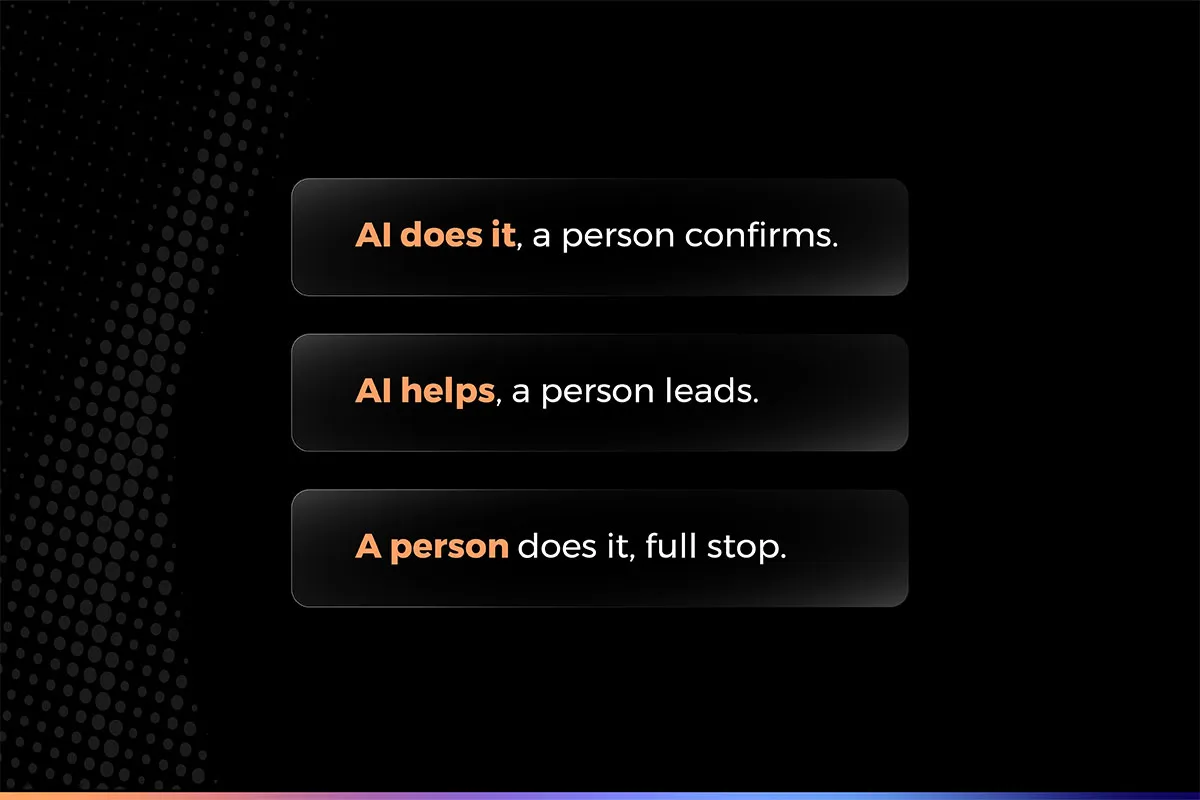
Instead of asking whether AI can replace accountants, ask where a person belongs in each piece of work. It helps to sort tasks into three groups.
1. AI can do it, and a person confirms it.
Gathering documents, pulling figures into a draft, comparing two versions of a schedule. The slow, repetitive first pass. The AI prepares it and a person checks it before it goes anywhere.
2. AI can help, and a person leads.
Analysis, explanations, a summary that will shape a decision. The AI offers a starting point. The person decides what is right, what to change and what to ignore.
3. A person does it, full stop.
Signing off, advising a client, handling anything delicate or unusual. These stay with people, because they depend on trust and accountability.
“AI can take the first pass. It cannot take the responsibility.”
Sort your own work in an hour
Where each task falls depends on your firm and your standards. The point is to decide it on purpose, instead of letting it happen by accident. You can start with a single hour.
- List ten tasks your team repeats every month.
- Put each one in a group: AI does it and a person confirms, AI helps and a person leads, or a person does it.
- For the first two groups, write down who reviews the result and what they check.
When you finish, you have something most firms do not yet have. A short, written map of where AI belongs in your work and where it does not.
What the team gets back
When the first pass moves to AI, people spend less time on the slow, repetitive work and more time on the part that needs a trained mind. For a firm that is short on people in busy season, that can be real relief.
The firm also keeps something it cannot afford to lose. Its people stay in charge, and every important decision still has a name next to it.
The takeaway
AI will change the work. It is not a replacement for the person who is accountable for it. The firms that do well will be the ones that decide, clearly, where AI helps and where people lead.
That is the thinking behind Vista, the Private AI from Archivista. It takes on the heavy first pass inside the firm’s own environment, and the firm’s people review, decide and sign.