
There's a moment in almost every compliance investigation that looks the same. A regulator asks for documentation of a specific decision. A date. A conversation. A record that proves what happened and when.
The organization searches. They find something that might be it: an email here, a note there. But the timestamps don't align perfectly. The context is incomplete. The record was modified after the fact.
"We have records," they say. "We're just not sure they'll hold up."
That uncertainty is expensive. In time, in legal exposure, and in trust.
The difference between having a record and proving one
Most organizations collect documents. They don't create records, in the legal and evidentiary sense of the word.
A record isn't just a file that exists somewhere. A record is a document with verified provenance, one that establishes what it is, when it was created, and that it has not been altered since.
Think of a notary. When a notary stamps a document, they're not adding information; they're adding certification. They're saying: this document is real, this is what it says, this happened at this time.
Most digital files have none of that. They exist. But they can be edited. They can be backdated. They can be challenged.
An ARC works on the same principle, automatically and continuously. Certified provenance, applied to every record an organization creates, without a manual step.
What makes an ARC different
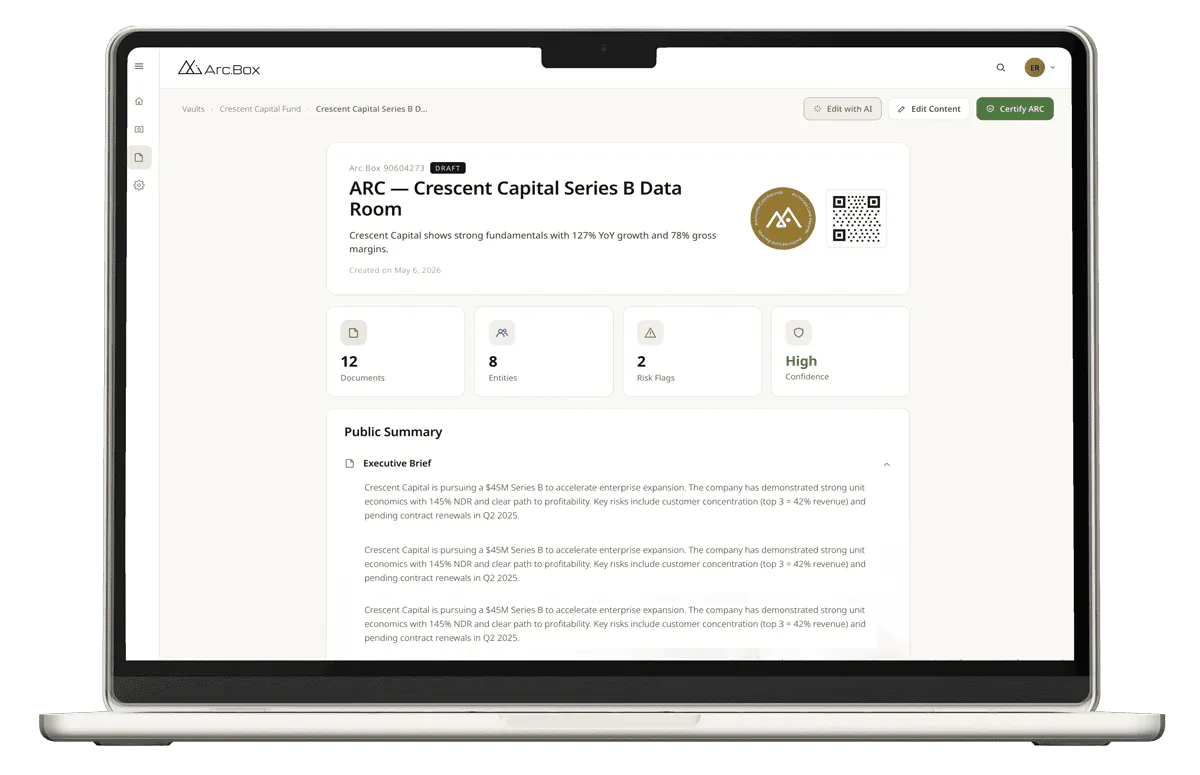
ARC stands for Authentic Record Container. It is the fundamental unit of how Arc.Box handles information.
When a record enters Arc.Box, it becomes an ARC. At that moment, several things happen simultaneously.
The record is sealed. Any change to the content (no matter how small) produces a detectable discrepancy. Not by policy. By math.
The exact moment of sealing is recorded independently, verifiable, and not subject to retroactive adjustment.
The record is stored in an environment that belongs to your organization, not to Arc.Box, not to any third party.
After that point, the integrity of the record does not depend on anyone's word. It is cryptographically provable. The seal is designed so that any alteration (however small) is detectable. That is what makes the record independently verifiable, and what makes it hold up when it needs to.
"It is not about having more records. It is about having records that actually hold up."
Why this matters more than most organizations realize
When regulators, auditors, or opposing counsel ask for records, the question is never just "do you have this?" It is: "can you prove this is what it was, when you say it was?"
Most organizations can answer the first question. Far fewer can answer the second.
ARCs change that. They transform ordinary records (emails, meeting notes, client communications, internal decisions) into tamper-evident, independently verifiable documentation that is built to withstand scrutiny.